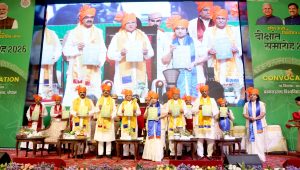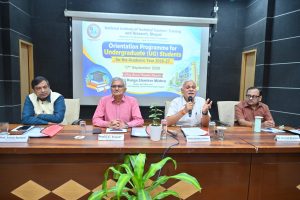
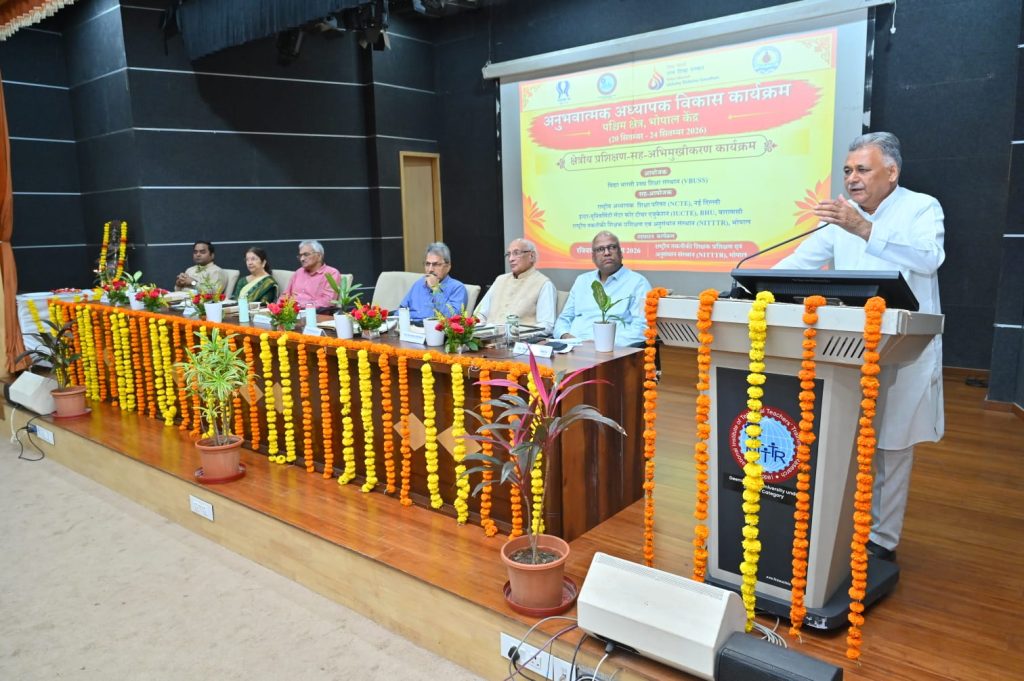
Bhopal: A one-week “Experiential Faculty Development Programme” was inaugurated on Sunday at the National Institute of Technical Teachers’ Training and Research (NITTTR), Bhopal. The programme is being organized under the joint aegis of NITTTR Bhopal, Vidya Bharati Uchcha Shiksha Sansthan, NCTE (New Delhi), and IUCTE (BHU).
Scheduled from September 20 to 24, the programme aims to familiarize teachers with the practical aspects of the Panchkoshiya (five-sheath) holistic development model and the Panchpadiya (five-step) teaching methodology, while re-establishing the Indian perspective on education.
Teachers and educationists from various states across the country are participating in the programme. Over the next four days, participants will visit schools run by Vidya Bharati in 31 districts of Madhya Pradesh to observe the practical application of the Panchkoshiya and Panchpadiya teaching methods.
During the inaugural session, Prof. C.C. Tripathi, Director of NITTTR, highlighted the institute’s innovative work in the fields of value-based education and the Indian Knowledge Tradition. He outlined the various innovations being implemented by the institute to make teacher training more effective.
The Chief Guest, Madhya Pradesh Higher Education Minister Shri Inder Singh Parmar, stated in his address that teachers should resolve to contribute to nation-building with a positive mindset. He remarked that the objective of education is not merely to impart knowledge but to foster the development of a student’s personality through a holistic understanding of the individual. A teacher possesses the power to bring about profound and lasting change in a student’s life.
Guest of Honour Dr. Kailash Chandra Sharma noted that while technological advancements have brought about significant changes in the teaching-learning process, education cannot be confined to technology alone. Alongside holistic development, it is essential to focus on the development of the students’ character, mind, and soul. Prof. Ravindra Kanhere emphasized that a teacher’s role is not just a job but a significant national responsibility.
In the first session, Shri Govind Mahant, National Organizing Secretary of Vidya Bharati Akhil Bharatiya Shiksha Sansthan, delivered an insightful lecture on “Panchkosh-based Holistic Development.” He elaborated on the concept of the balanced development of the Annamaya, Pranamaya, Manomaya, Vigyanamaya, and Anandamaya Koshas as described in the Indian educational perspective, and highlighted the importance of holistic development in education.
In the second session, Shri Deshraj Sharma, National General Secretary of Vidya Bharati, held a detailed discussion on the “Panchpadiya Teaching Methodology.” He outlined various aspects of making teaching more effective, engaging, and student-centric through the five stages: Adhiti (acquisition), Bodha (comprehension), Abhyasa (practice), Prayoga (application), and Prasara (dissemination). He stated that education should align with the nation’s needs and societal expectations. Emphasizing the uniqueness of Indian values and educational traditions, he described education as a laboratory for holistic development.
In the third session, Prof. Meena Chandawarkar (NCTE), Dr. Raja Pathak (IUCTE), and Prof. Madhusudan J.V. (FDP Coordinator) shared their views on the future of teacher education in India and the role of teachers.
The event was attended by Shri K.N. Raghunandan (National Organizing Secretary, Vidya Bharati Higher Education Institute), Dr. Shashiranjan Akela (National Vice President and Program Coordinator), Prof. Meena Rajiv Chandawarkar, Prof. S.P.S. Rajput, Dr. Raja Pathak (IUCTE, Varanasi), Prof. P.K. Purohit (Chairman of the Organizing Committee, NITTTR Bhopal), and Dr. R.S. Chauhan, alongside teacher-educators and faculty members from higher education institutions across various states.
The programme was conducted by Smt. Babli Chaturvedi and the vote of thanks was proposed by Dr. Shashi Ranjan Akela.
This experiential faculty development programme is being organized as a significant initiative to connect teachers with the Indian Knowledge Tradition, the holistic educational perspective, and its practical application in the classroom.