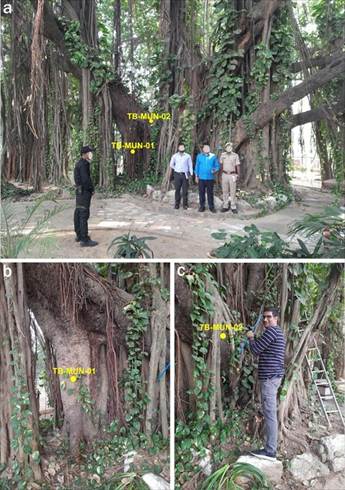
A banyan tree in Munger, Bihar, estimated to be around 700 years old, has been identified as the oldest accurately dated banyan tree, using radiocarbon dating, a method that relies exclusively on scientific evidence rather than historical records or local lore. The Heritage Banyan tree is growing at ITC campus, Munger, Bihar, India.
Banyan trees, with their intricate root and branch networks, provide habitats for a variety of wildlife, including birds and insects. They have also played a significant role in Indian social and cultural life for centuries.
Traditionally, estimating their age relied on folklore, local stories or historical records, which were often inaccurate. These living representations of history were not scientifically dated previously due to a lack of a clear protocol.
When Dr. Trina Bose from the Birbal Sahni Institute of Palaeosciences, Lucknow, an autonomous institute under the Department of Science and Technology (DST), was invited by the Bihar Forest Department to investigate and determine the age of the Munger Banyan tree, she recognised the limitations of conventional dating approaches for tropical broadleaf species.
To address this challenge, she initiated the development of a new scientific approach for age determination. Dr. Bose led a research team comprising Dr. Mayank Shekhar and Dr. Akhilesh K. Yadava, who collaboratively developed and applied an innovative methodology to establish the age of the tree.
The research published in the journal Quaternary Research provides a scientific method for accurately dating heritage trees, helping governments, forest departments, and conservation agencies identify and protect culturally and ecologically important trees. It strengthens the preservation of natural and cultural heritage by replacing uncertain age estimates with reliable scientific evidence.
The methodology can also be applied to other ancient tropical trees worldwide and can help biodiversity conservation, heritage management, environmental education, and research on past climate and historical landscapes.
This research represents a major breakthrough in the scientific dating of ancient trees in tropical regions, especially those of cultural significance, such as the Banyan, and will not only help determine the age of such trees more accurately but also support efforts to preserve natural, historical, and cultural heritage throughout South Asia and beyond.