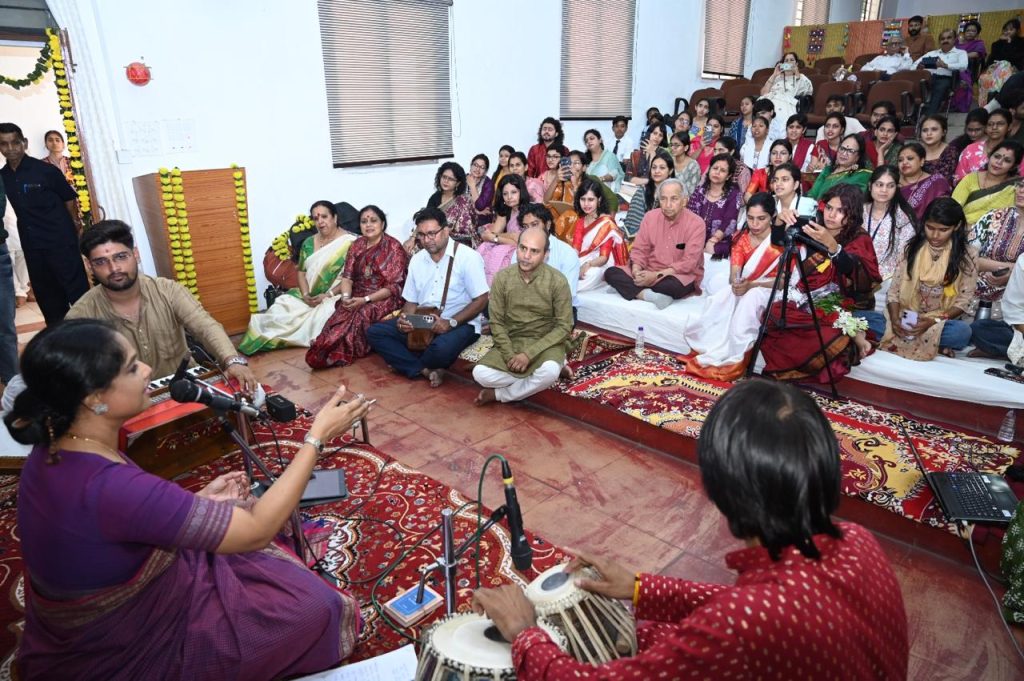
Bhopal: The four-day National Workshop on Thumri and Dadra Vocal Training, organized by the Department of Music at Government Sarojini Naidu Girls’ PG College, Shivaji Nagar, Bhopal, concluded on Saturday in a deeply moving and celebratory atmosphere.
The valedictory session featured performances by participants, who captivated the audience with the skills and insights they had acquired during the workshop.
Renowned vocalist and chief resource person Vidushi Indrani Mukherjee said in her address that only the proper use of modulation and emotion, aligned with the raga, melody, and lyrics, can make singing reach the hearts of listeners. She emphasized that music is not merely an arrangement of notes but a powerful medium of emotional expression, where words must be infused with soul and melody with sensitivity.
The concluding programme began with a group presentation by the participants, who performed Pandit Balwant Rai Bhatt’s composition “Sadh Le Nar Shadj Apna, Swar Tumhare Hain Sabhi” in Raga Bhoopali. This was followed by the monsoon-themed compositions “Barsi Kari Re Badariya” and “Jhoola,” which had been taught during the workshop and were warmly appreciated by the audience.
The most poignant moment of the evening came when Vidushi Indrani Mukherjee presented Pandit Dinkar Kaikini’s celebrated bandish “More Naina Barsan Lage” in Raga Kirwani. Her deeply expressive and emotionally charged rendition transported the audience into a profound world of feeling. The pathos and sensitivity of her performance moved many listeners to tears, and the auditorium resonated with prolonged applause.
The chief guest at the valedictory ceremony was Shekhar Karadkar, Deputy Director of the Ustad Alauddin Khan Academy of Music and Arts. Ms. Bharti Singh Rajput, Deputy Director, Department of Culture, was the guest of honour.
Among those present were the college principal Dr. Surendra Bihari Goswami, faculty members, noted litterateur and poet Bhadra Vasti, art promoter Sunil Shukla, senior paediatrician Dr. Anshu Narang, musicians, academicians, research scholars, and a large number of music enthusiasts.
In their remarks, the guests described such workshops as an important means of carrying India’s rich musical traditions to younger generations. They appreciated the efforts of the Department of Music and observed that initiatives of this nature help students gain a deeper understanding of both classical and semi-classical music traditions.
At the conclusion of the programme, Dr. Neena Srivastava, Head of the Department of Music and Workshop Coordinator, expressed gratitude to all guests, participants, and supporters. She said that the objective of the workshop was not merely to teach singing but also to introduce participants to the emotional and cultural heritage of Indian music, a goal that had been successfully achieved. She further expressed the hope that similar workshops would continue to be organized on a regular basis in the future.