
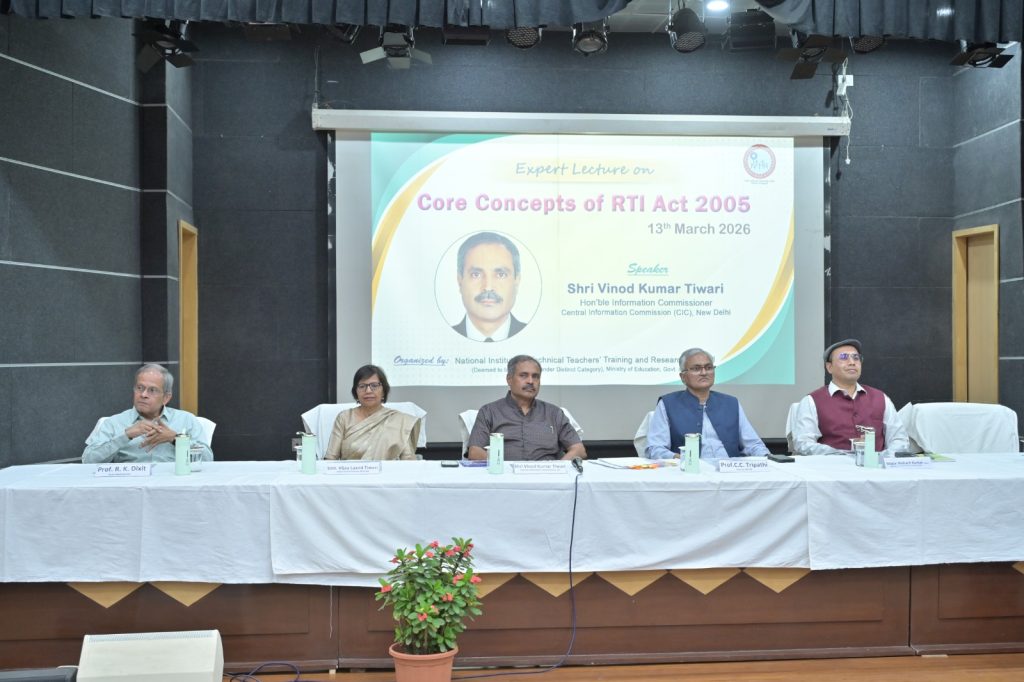
A special lecture session was organized at the National Institute of Technical Teachers’ Training and Research (NITTTR), Bhopal, on the subject: “Core Concepts of Right to Information (RTI) Act, 2005.” The session was addressed by the keynote speaker, Vinod Kumar Tiwari, Information Commissioner, Central Information Commission (CIC), New Delhi.
The objective of this lecture was to provide participants with information regarding the fundamental principles of the RTI Act, the challenges encountered in its implementation, and best practices. This initiative will significantly aid in strengthening the framework of transparency within institutions and ensuring effective compliance with the law.
Addressing the audience—comprising CPIOs, FAAs, APIOs, RTI Nodal Officers, and other officials and employees associated with RTI-related matters from various institutions—Vinod Kumar Tiwari stated that the Right to Information is not merely a legal provision; rather, it is a social instrument that ensures transparency in administration and fosters citizen participation.
IT IS THE RESPONSIBILITY OF OFFICIALS TO PROVIDE ACCURATE INFORMATION
Tiwari noted that the implementation of RTI has been highly effective thus far, with a citizen satisfaction rate standing at approximately 95%. He emphasized that it is the responsibility of every official to provide accurate information to the public in a timely manner regarding “public funds and public resources.”
UNDER-DISCLOSURE POSES A SIGNIFICANT CHALLENGE
Citing recent amendments to the RTI Act and several landmark judicial decisions, he provided comprehensive insights into the rules and statutes governing the CIC. Advocating for the adoption of a ‘proactive’ approach to foster transparency within the RTI ecosystem, Tiwari remarked that while there is no objection to ‘over-disclosure’ (providing more information than strictly required), it is ‘under-disclosure’ (providing insufficient information) that poses a significant challenge to the rights of citizens.
On this occasion, while candidly answering questions from the participants present, he urged everyone to leave behind a legacy for the coming generation—one characterized by transparency in governance and administration.
TRANSPARENCY AND ACCOUNTABILITY ARE INSTITUTE’S PRIORITIES: TRIPATHI
Prof. Chandra Charu Tripathi, Director of NITTTR Bhopal, lauded Tiwari’s enlightening session, remarking that it held immense significance for all the officers and staff members in attendance. He noted that transparency and accountability rank among the institute’s core priorities.
He said the clarity and practical perspective with which Tiwari elucidated the RTI Act, and its successful implementation not only provided the officers with a comprehensive understanding of their obligations toward citizens but also offered guidance on how to render the institute’s operational mechanisms more effective and accountable. He emphasized that for the successful implementation of the RTI Act, institutional processes must be simple and transparent, and employees should be provided with regular training and guidance.
The session focused on transparency, accountability, and the effective implementation of the RTI Act. Directors, Registrars, and RTI-related officers and staff members from various institutions across Madhya Pradesh and Uttar Pradesh, Smt. Vijay Lakshmi Tiwari (Retd. IFS), from the Institute Prof. R.K. Dixit, CPIO Major Nishant Kumar, and others were present on the occasion. The session was moderated by Administrative Officer Gautam Kumar Singh.