
By: MEDHA BAJPAI, Educator and Columnist
National Science Day-2026: National Science Day is an occasion for us to remember the crucial role of women in scientific progress for the development of a “Viksit Bharat” (Developed India). Although the number of women in the fields of science and technology in India has been gradually increasing, their participation in high-level research and leadership positions remains relatively low. However, in the last five years, women have made significant strides in research institutions, space programs, and medical sciences.
There are many events in life that are beyond an individual’s control, often governed by infinite consciousness. Only a few extraordinary talents are able to transform knowledge through their contemplation and creativity, making it eternal. C.V. Raman was one such exceptional talent.
Until a few years ago, diabetes patients had to prick themselves with needles multiple times a day to test their blood sugar levels. But now, without a blood test, it is possible to detect cancer, glucose, cholesterol, and uric acid levels directly from the skin.
This process is based on the Raman Spectrum technique, which allows precise diagnosis through the color of the blood. The use of the Raman Effect in medical treatment is revolutionizing non-invasive (without surgery or internal instruments) diagnostic techniques.
The Raman Effect is one such discovery, made by Indian physicist Sir C.V. Raman in 1928. This research has a fascinating story.
.V. Raman, a renowned physicist, was born on November 7, 1888, in a middle-class family in Tiruchirapalli, Tamil Nadu. Despite excelling in his studies, he started his career in a government job as an assistant accountant general in Kolkata. That year, he also got married, and life was progressing as usual.
However, Raman was not meant for a conventional life. One day, while returning from his office, he saw a signboard that read “Indian Association for the Cultivation of Science.” It seemed like his life was about to take a new direction. He immediately went to the association’s office, introduced himself, and got permission to work in their laboratory.
Became a professor at Calcutta University
Due to his interest in physics and mathematics, he resigned from his government job and became a professor at Calcutta University in 1917. At that time, he was researching the science of Indian musical instruments.
Raman’s family was deeply rooted in music. His father, Chandrasekhar Ayyar, was a violinist, his wife Lokasundari Ammal was an expert in playing the veena, his mother Parvati was a scholar of Sanskrit, and Raman himself played the mridangam.
His research was based on the scientific analysis of sound in musical instruments. His research papers on the sound of violins and various drums were published in the prestigious scientific journal Nature. In 1926, when plans were made to publish a scientific encyclopedia in Germany, Raman was invited as the only non-European author to write about “The Physics of Musical Instruments.”
A turning point in his life
In 1921, Raman was invited to the University of Oxford, UK, to represent India at the British Commonwealth Universities Congress. This journey marked a turning point in his life. The sea voyage provided him with uninterrupted time to think, and he became fascinated by the blue color of the sea and the sky. Scientists had previously explained the blue color of the sea as a reflection of the sky, but Raman was not satisfied with this explanation. He pondered the question, “Why is the sky and sea blue?” This became the subject of his research after he returned from Britain.
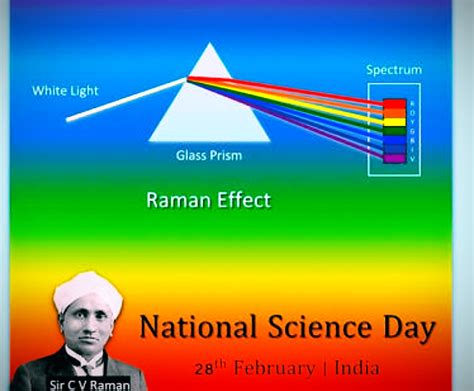
According to the Raman Effect, when a beam of light passes through a transparent substance (such as water, glass, or gas), there is a change in the color of the light. This means that when light strikes a substance, its energy undergoes a slight change, causing the color of the light to shift. This change depends on the properties of the substance.
A stir in the global scientific community
This discovery and its logical explanation created a stir in the global scientific community. Although many Western scientists initially did not accept this discovery, Raman continued his research and proved it. At that time, India had limited resources and facilities for high-level research compared to Western countries. Yet, through his hard work and commitment, Raman was able to discover the Raman Effect.
Was awarded the Nobel Prize in 1930
In 1928, C.V. Raman was nominated for the Nobel Prize in Physics, and in 1930, he was awarded the Nobel Prize, which was a well-deserved recognition of his relentless hard work, struggle, and patience.
To undertake difficult work or to venture into unknown territories requires not just a little skill but also a lot of courage. Albert Einstein’s words ring true for Sir C.V. Raman.
Raman Effect is used in various fields
Today, the Raman Effect is used in various fields. When India’s space mission Chandrayaan announced the presence of water on the moon, the Raman Spectroscopy technique was instrumental in making that discovery. National Science Day is celebrated to honor the immense contributions of Indian scientists, particularly remembering Sir C.V. Raman’s discovery of the Raman Effect.
In 2026, National Science Day will be celebrated with the theme “Women in Science,” emphasizing the crucial contributions women have made in the field of science and encouraging future generations to engage with scientific pursuits.