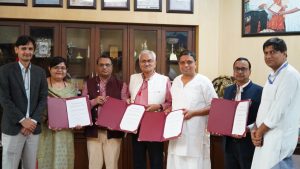
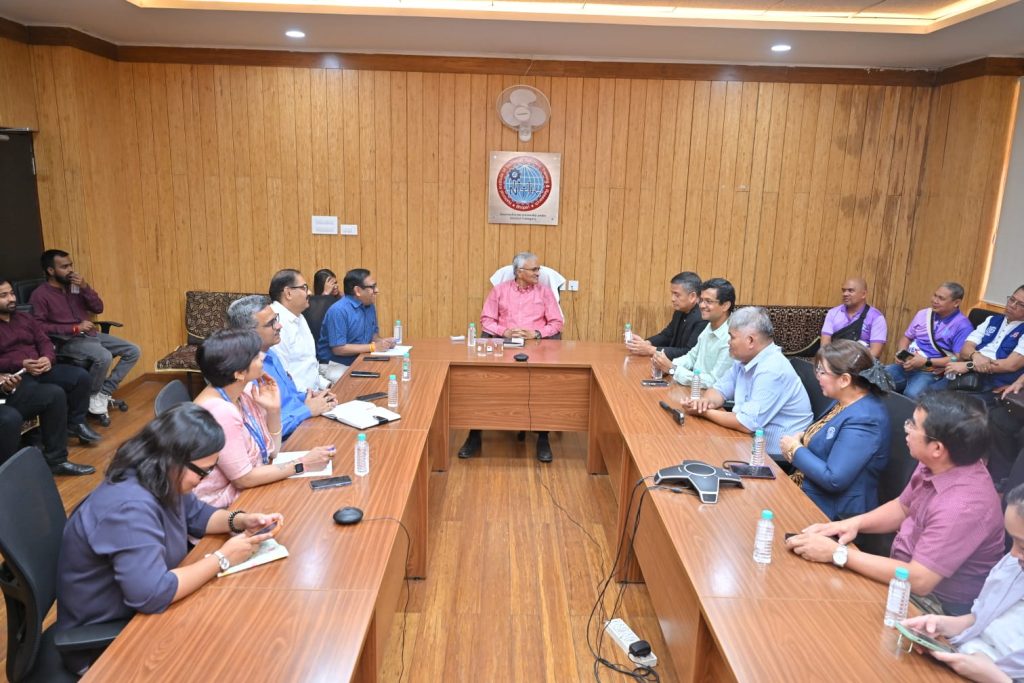
NITTTR (National Institute of Technical Teachers’ Training and Research), Bhopal, hosted a high-level delegation from the Technical Education and Skills Development Authority (TESDA), Philippines. This visit was part of an international exposure initiative under the SIPTVETS project and proved to be a significant step toward strengthening global partnerships in Technical and Vocational Education and Training (TVET).
The program commenced with an inaugural session, featuring a welcome address delivered by Prof. R.P. Khambayat. Information regarding the institute and the Siemens Centre of Excellence was presented by Prof. (Dr.) Manish Bhargava, Professor and Head of Department (DTVE) and Project Director.
Additionally, Dr. R.S. Chauhan and Prof. Pallavi Bhatnagar delivered presentations on the curriculum and the OSAT Lab, tailored to meet TESDA’s specific requirements. The delegation comprised senior officials from TESDA, led by Director III Gilbert M. Castro and Director III Stephen I. Cesar.
Subsequently, a comprehensive technical session was held, during which innovative initiatives regarding capacity building, curriculum development, and digital platforms—such as ‘e-Prashikshan’—were presented. During this session, meaningful deliberations took place concerning modern pedagogical methods, competency-based training, and the integration of emerging technologies into vocational education.
The TESDA delegation also toured NITTTR Bhopal‘s state-of-the-art facilities, which include Centres of Excellence in Product Design, Additive Manufacturing, Mechatronics, Robotics, IoT, Industrial Automation, and 3D Metal Printing. The delegates commended the institute’s strong focus on Industry 4.0 technologies and experiential learning.
During the concluding session, Director Prof. Chandra Charu Tripathi shared her insights, emphasizing the critical importance of international collaboration in transforming TVET systems. He remarked, “Today, the world has evolved into a global village, where collaboration, knowledge exchange, and mutual learning are absolutely essential.”
Prof. Tripathi highlighted the relevance of India’s National Education Policy (NEP 2020) and emphasized the need to integrate vocational education into the mainstream education system. He encouraged TESDA to establish alignment with the National Credit Framework (NCrF) to foster flexibility, mobility, and opportunities for lifelong learning.
He also placed special emphasis on introducing and strengthening diploma and vocational programs aligned with industry requirements, as well as on outcome-based education, competency standards, and industry-integrated training models.
Finally, interacting with the delegation, the Director discussed their experiences and expectations, and reiterated NITTTR Bhopal’s commitment to long-term institutional partnerships.