
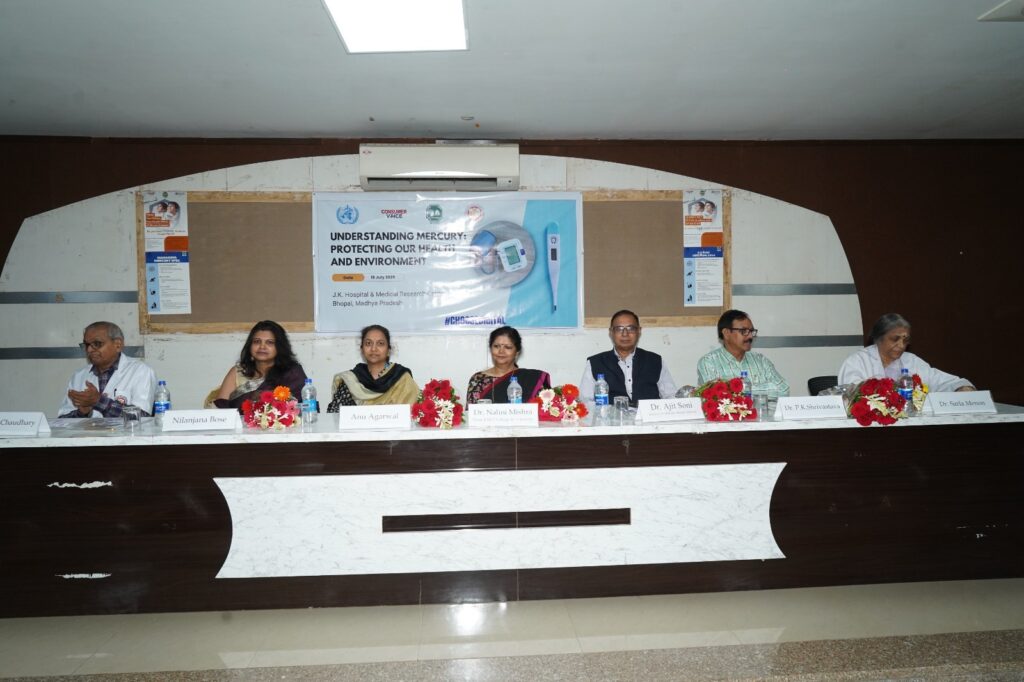
Bhopal: Madhya Pradesh: In a compelling call to action, leading public health experts, government officials, civil society organisations, and environmental advocates have emphasized the urgent need to phase out mercury-containing medical devices—such as thermometers and blood pressure monitors (sphygmomanometers)—across India.
This appeal was made during a workshop jointly organised by Consumer VOICE and the National Centre for Human Settlements and Environment (NCHSE) to raise awareness about the health hazards of mercury exposure, especially for women and children, and to reaffirm India’s commitment to the Minamata Convention on Mercury.
Mercury-based devices, though safe when intact, become highly dangerous when broken or improperly discarded. Upon exposure, mercury evaporates into toxic vapours that pose serious health risks through inhalation or skin contact. Mercury can damage the lungs, kidneys, and nervous system, and contaminate air, soil, and water, eventually entering the food chain and affecting entire populations.
“India, as a signatory to the Minamata Convention, is committed to phasing out mercury-based medical devices,” said Dr. Pradip Nandi, Director General of NCHSE. “This international agreement is aimed at protecting both human health and the environment from mercury emissions and releases.”
Recognized by the World Health Organization (WHO) as one of the top 10 chemicals of major public health concern, mercury—even in small amounts—can cause neurological, digestive, and immune system damage, particularly in children. Once released into the environment, it transforms into methylmercury, a potent neurotoxin that accumulates in the food chain and is especially harmful to pregnant women and unborn children.
Dr. P. K. Shrivastava, scientist from the Madhya Pradesh Pollution Control Board, stressed the importance of safe handling: “Strict mercury spill management protocols must be followed not only in hospitals but also at home. It’s time we switch to mercury-free digital alternatives to safeguard future generations.”
Eight tonnes of mercury released annually from medical devices
A study by Toxics Link (2011) revealed that approximately eight tonnes of mercury were being released annually from medical measuring devices in India, with 69% attributed to the mismanagement of discarded sphygmomanometers.
Dr. A. K. Choudhury, Director Medical, J. K. Hospital, Bhopal, highlighted the grave risks of mercury exposure: “For women and unborn foetuses, mercury exposure can be fatal. Transitioning to digital thermometers and BP machines is not only life-saving but environmentally responsible.”
Other eminent speakers—Dr. Nalini Mishra (Dean, LN City University), Dr. Ajit Soni (Registrar, LN City), and Dr. Sarla Menon (Medical Superintendent, JK Hospital)—also advocated for a swift move to mercury-free digital medical devices and more robust waste management systems.
“Digital devices are accurate, affordable, and widely available. The healthcare sector is leading the way—now it’s time for every household to follow,” urged Nilanjana Bose, Project Head (Food & Nutrition), Consumer VOICE, a Delhi-based consumer organisation working on health and safety issues for over three decades.
The workshop concluded with a clear message: eliminating mercury-based medical devices and improving consumer awareness are essential steps in protecting human health and preserving our planet for future generations. More than 150 participants, including youth, women, consumers, and civil society representatives, attended the workshop, underscoring growing concern and public interest in mercury-related health and environmental issues. The workshop was organised at J K Hospital and Research Centre.