From the food streets of Indore to the cement hubs of Satna and the looms of Maheshwar, Madhya Pradesh’s economy is deeply rooted in agriculture, crafts and industry. The recent GST rate rationalisation is expected to ease costs across these diverse sectors, making essentials more affordable for households and improving competitiveness for producers.
Known for its rich diversity, ranging from GI-tagged snacks and sarees to tribal crafts, stonework and cement, Madhya Pradesh now stands to gain from lower tax rates on a wide range of goods. The reforms are expected to support farmers, artisans, MSMEs and large industries alike, opening new opportunities for growth and livelihoods.
Indore Namkeen
Indore is a GI-tagged hub for savouries like sev, laung sev, mixture and chivda. The sector supports nearly 1 lakh direct and 2.5 lakh indirect jobs, with exports reaching the Middle East, UK, and US. With GST on namkeens cut from 12% to 5%, products are expected to be about 6–7% cheaper. This will encourage higher domestic sales and improve the competitiveness of exports.
Maheshwari Sarees
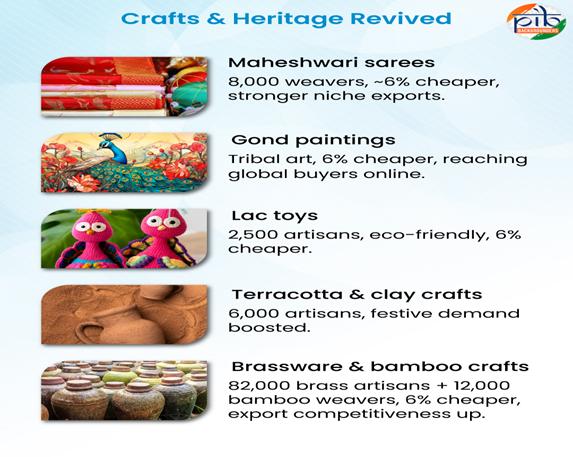
The Maheshwari handloom sector in Khargone district sustains around 8,000 weavers across 2,600 looms, with women playing a vital role in winding, spinning and dyeing. The craft has deep historical roots, it was revived and promoted in the 18th century by Ahilyabai Holkar, whose royal patronage established Maheshwar as a renowned weaving hub.
Known for their lightweight silk-cotton blend, subtle colours and distinctive reversible borders (bugdi), Maheshwari sarees continue to enjoy strong domestic demand and niche exports, supported by a GI tag since 2010. Exports reach Europe and the US, often through NGOs and boutique collaborations.
With GST on finished textile products up to Rs 2,500 reduced from 12% to 5%, these sarees are expected to be about 6% cheaper in the mass and mid-range segment. This improves affordability for urban buyers, enhances competitiveness against synthetic alternatives, and provides greater income stability to weaver households.
Tribal and Folk Crafts
Gond Paintings: A GI-tagged art form since 2015, Gond paintings are produced in Mandla, Dindori, Umaria and Seoni, largely in household-based units. Rooted in folklore and mythology, the paintings portray local flora, fauna and legends, with women playing an equal role in the craft. Domestically, they are sold in craft fairs, galleries and urban décor stores, while international demand comes from collectors, museums and online buyers in Europe and the US. Gond art has also been showcased at international exhibitions in Paris and London, highlighting its global appeal.
With GST reduced from 12% to 5%, artworks are expected to be about 6% cheaper, giving artists a stronger edge in galleries, e-commerce and export markets, while supporting stable incomes for tribal families.
Wooden Lac Toys: Produced mainly in Budhni (Sehore), Ujjain and Gwalior, this hereditary craft is sustained by about 2,000–2,500 artisans, with women contributing significantly in painting and finishing. Made on traditional hand-turned lathes and often coloured with non-toxic vegetable dyes, these toys are valued as eco-friendly alternatives to plastic. With GST reduced from 12% to 5%, prices fall by about 6%, boosting affordability against plastic substitutes, strengthening sales during festivals and fairs, and improving prospects in export markets such as Japan and Europe.
Terracotta and Clay Crafts: Mandla, Betul, Ujjain and Tikamgarh are known for terracotta toys, idols and décor, produced mainly by rural and women-led households. Around 5,000–6,000 artisans, mostly from rural and SC/ST households are engaged in this eco-friendly craft, with demand peaking during Diwali and Navratri. With GST reduced from 12% to 5%, products are expected to be about 6% cheaper, supporting festival sales and strengthening artisan livelihoods.
Bell Metal and Dokra Craft: In the tribal belts of Betul and Balaghat, about 5,000 artisans are engaged in the heritage craft of dokra, which uses the traditional lost-wax casting method to produce idols, figurines, jewellery and décor.
Linked closely to Madhya Pradesh’s tribal heritage, this art form is valued for being entirely handmade and unique in finish, and is sold both through domestic handicraft emporia and to niche collectors in Europe and the US. With GST reduced from 12% to 5%, products are expected to be around 6% cheaper, enhancing competitiveness against machine-made brass idols and helping sustain incomes for artisan households.
Lacquerware and Bell Metal Crafts: Clusters in Tikamgarh, Jhabua and Alirajpur produce lacquerware and ritual bell metal objects, sustaining around 5,000–6,000 artisans. Domestically, these items are widely used in religious rituals, weddings and décor, while exports cater to niche markets in Europe and the US. Bell metal objects hold ritual significance in central Indian traditions, and lacquerware is valued for its bright colours, especially in rural fairs.
NGO-led cooperatives also help artisans access urban buyers. With GST reduced from 28% to 18% on certain bell metal products and from 12% to 5% on lacquerware, consumer prices are expected to fall by 6–10%, strengthening market opportunities in domestic fairs and boosting export visibility.
Bamboo and Cane Handicrafts: In Balaghat, Mandla and Dinora, thousands of tribal households are engaged in weaving baskets, mats, furniture and decorative items from bamboo and cane. Women play a central role in this eco-friendly craft, which sustains about 12,000 direct and 25,000 indirect livelihoods. The sector is promoted through TRIFED and the Van Dhan Yojana, as well as the Madhya Pradesh Forest Development Corporation.
With GST reduced from 12% to 5%, bamboo and cane products are expected to be around 6% cheaper, improving affordability in domestic décor markets, strengthening tribal incomes, and boosting exports of eco-friendly goods to Europe and the Middle East.
Brassware: Tikamgarh, Chhatarpur and Betul are major centres of brassware, where hereditary artisan families craft utensils, lamps and decorative pieces through traditional casting and engraving. The sector engages thousands of artisans, with more than 82,000 enrolled under the government’s Pahchan initiative in 2021. Domestically, brassware continues to be used in temples, households and décor, while exports reach markets in the Middle East, US and Europe.
With GST on brassware reduced from 12% to 5%, prices are expected to fall by about 6%, helping artisans compete against stainless steel and aluminium substitutes while also expanding export competitiveness.