
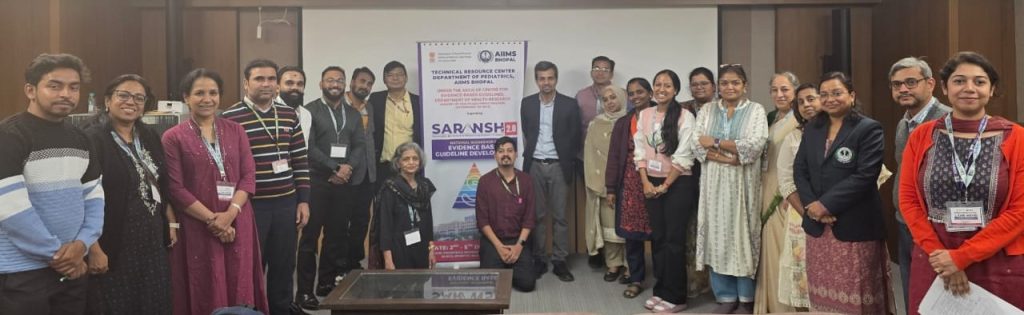
The Department of Pediatrics at AIIMS Bhopal, in collaboration with the Department of Health Research (DHR), Ministry of Health and Family Welfare, successfully conducted the four-day national workshop ‘SARANSH 2.0’ from 2nd to 5th December 2025. The workshop aimed to make healthcare services in India more accurate, reliable, and evidence-based so that common citizens can receive safer and more effective treatment.
The workshop was inaugurated by Executive Director & CEO Prof. (Dr.) Madhabananda Kar. In his address, he stated that the COVID-19 pandemic clearly demonstrated the need for timely, evidence-based clinical guidelines. He also emphasized that a strong, evidence-driven healthcare system will play a key role in achieving the national vision of Viksit Bharat 2047.
During the workshop, experts explained that the Department of Health Research (DHR) is leading India’s transition from traditional consensus-based approaches to robust, evidence-based clinical guidelines. This shift ensures greater clarity, transparency, and global credibility in treatment recommendations. Just as countries like the United Kingdom (NICE), Australia (NHMRC), and the United States (AHRQ) develop guidelines suited to their populations, India is also creating its own scientific and culturally aligned clinical guidelines.
Under this initiative, eight national stem cell guidelines have already been published, and sixteen more are under development. A strong network of 27 Technical Resource Centres and 6 Technical Resource Hubs is supporting this effort with high scientific standards.
The four-day ‘SARANSH 2.0’ featured focused academic sessions and practical training on evidence-based guideline development by renowned national experts—Prof. (Dr.) Joseph Mathew, Dr. Vikas Dhiman, Dr. Jitendra Meena, Dr. A. G. Radhika, and Dr. Roopa Hariprasad. The program concluded with a vote of thanks by Prof. (Dr.) Girish C. Bhatt (Principal Investigator, DHR-TRC) and Dr. Garima Dubey (Research Associate-III).
‘SARANSH 2.0’ stands as an important achievement for India, ensuring that future clinical decisions are based on strong scientific evidence. This will provide common citizens with safer, more effective, and more reliable healthcare services and further strengthen the country’s health system on the path towards Viksit Bharat 2047.