Dr. P.K. Purohit
August 23 holds a special place in India’s scientific history. In 2026, the nation observed the fourth National Space Day, commemorating the historic achievement of Chandrayaan-3, which successfully soft-landed on the Moon on August 23, 2023.
With this achievement, India became the fourth country in the world to accomplish a soft landing on the Moon and the first to land in the region near the lunar south pole. National Space Day has now evolved beyond the celebration of a single mission. It has become an occasion to reflect on India’s remarkable scientific journey, technological capabilities, growing space ecosystem and aspirations for the future.
India’s space programme has travelled an extraordinary distance—from modest beginnings at Thumba to sophisticated missions to the Moon, Mars and the Sun. Today, the country is preparing for human spaceflight, space docking, advanced Earth observation, lunar exploration and the establishment of an Indian space station. This transformation represents not merely technological progress but also the growing strength of India’s scientific and industrial ecosystem.
From Thumba to the Moon
The foundations of India’s space programme were laid under the visionary leadership of scientists such as Dr. Homi Jehangir Bhabha and Dr. Vikram Sarabhai. The establishment of the Indian National Committee for Space Research (INCOSPAR) in 1962 and the subsequent formation of the Indian Space Research Organisation (ISRO) in 1969 marked important milestones in this journey.
On November 21, 1963, India launched its first sounding rocket from Thumba Equatorial Rocket Launching Station in Kerala. At that time, India possessed limited resources, but the scientific ambition was immense. Over the following decades, the country developed indigenous satellites, launch vehicles, communication systems, remote-sensing capabilities and navigation technologies.
The launch of Aryabhatta in 1975, India’s first satellite, was an important milestone. In 1980, the successful launch of the Rohini satellite aboard the indigenous SLV-3 demonstrated India’s growing launch capability. This was followed by the development of INSAT, IRS, GSAT, Cartosat and NavIC systems, which brought space technology closer to everyday life and national development.
One of the defining characteristics of India’s space programme has been its ability to achieve sophisticated technological outcomes through efficient use of resources. This approach created the confidence and capability required for increasingly ambitious missions such as Chandrayaan, Mangalyaan and Aditya-L1.
Chandrayaan: A New Direction for Lunar Exploration
India’s first lunar mission, Chandrayaan-1, launched in 2008, laid the foundation for the country’s lunar exploration programme. The mission provided important evidence of the presence of water molecules on the Moon and significantly contributed to global lunar science.
Chandrayaan-2, launched in 2019, took India’s lunar ambitions further. Although the Vikram lander could not achieve a successful soft landing, the mission’s orbiter entered lunar orbit successfully and continued to provide valuable scientific data.
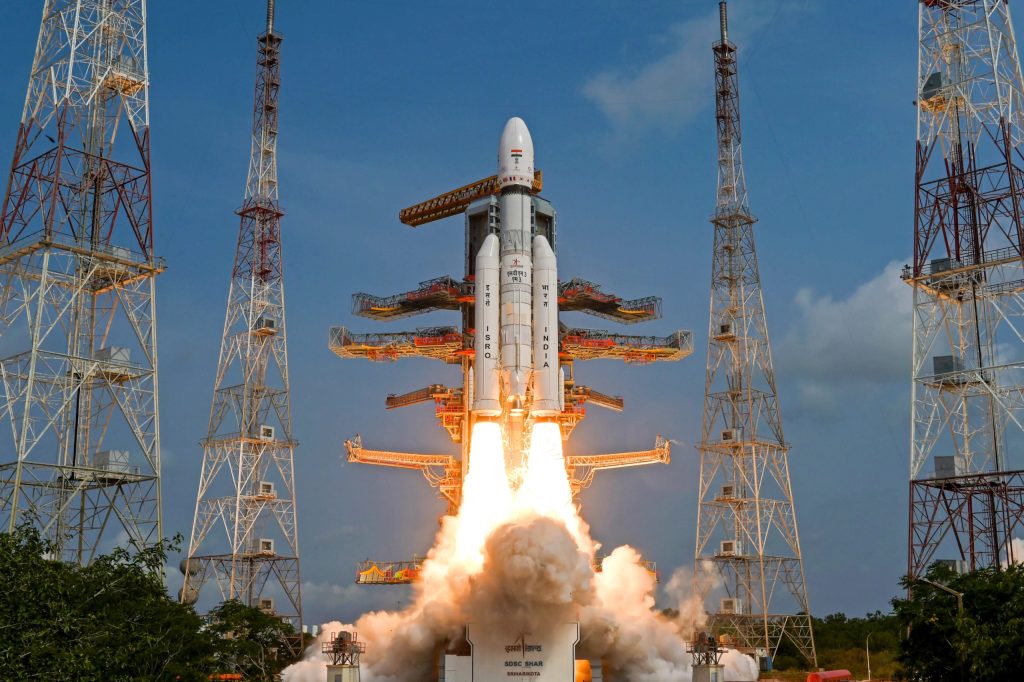
The experience gained from Chandrayaan-2 proved invaluable in preparing for the next attempt. On August 23, 2023, Chandrayaan-3 successfully soft-landed on the lunar surface, marking a historic moment for India. The Vikram lander and Pragyan rover conducted scientific experiments and demonstrated India’s capability to undertake complex planetary missions using indigenous technology and expertise.
The achievement significantly strengthened India’s position among the world’s leading spacefaring nations and became the inspiration for the observance of National Space Day.
From the Moon to the Sun
After reaching the Moon, India turned its scientific attention towards the Sun. Aditya-L1, India’s first dedicated solar mission, was launched on September 2, 2023, and successfully entered its designated halo orbit around the Sun-Earth L1 point in January 2024.
The mission is studying the solar corona, solar plasma and solar activity and is contributing valuable observations to the understanding of the Sun and space weather. Understanding solar activity is important not only from a scientific perspective but also for modern technological infrastructure. Solar storms can affect satellites, communication networks, navigation systems and power infrastructure on Earth. Missions such as Aditya-L1 therefore have implications extending well beyond fundamental science.
SpaDeX: Mastering Space Docking
India’s space programme is no longer focused only on launching satellites into orbit. Future complex missions will require spacecraft to rendezvous, dock and operate together in space. The Space Docking Experiment (SpaDeX) represents a significant technological achievement in this direction.
On January 16, 2025, ISRO successfully demonstrated the docking of two SpaDeX satellites. The satellites were subsequently successfully undocked on March 13, 2025. This demonstrated India’s capability in rendezvous, docking and undocking operations in space. Such technology is essential for future human spaceflight, space-station operations, satellite servicing, sample-return missions and complex lunar exploration. Space docking capability is therefore an important technological foundation for India’s long-term human and lunar exploration ambitions.
NISAR: Space Technology for Earth
The significance of India’s space programme extends far beyond scientific prestige. Space technology has become an important tool for national development, supporting agriculture, weather forecasting, disaster management, telecommunications, navigation, water-resource management and environmental monitoring. The NASA-ISRO Synthetic Aperture Radar (NISAR) mission is an excellent example of international scientific cooperation. The mission combines the capabilities of NASA and ISRO to observe changes on Earth’s surface.
NISAR data have applications in agriculture, soil-moisture monitoring, environmental studies, disaster management and the study of changes in the Earth’s surface. In February 2026, ISRO announced the development of 100-metre-resolution soil-moisture products based on NISAR observations. Such products can support crop monitoring, irrigation planning, drought assessment and water-resource management. The growing availability of space-based data demonstrates how space science can directly contribute to improving life on Earth.
Gaganyaan: India Prepares for Human Spaceflight
One of India’s most ambitious near-term goals is Gaganyaan, the country’s human spaceflight programme. The objective is to demonstrate India’s capability to send Indian astronauts into low-Earth orbit and safely return them to Earth.
Human spaceflight involves far more than the development of a powerful launch vehicle. It requires highly reliable crew escape systems, life-support systems, parachutes, medical facilities, communication systems, astronaut training and recovery mechanisms.
Various tests under the Gaganyaan programme are designed to validate these critical systems. Integrated air-drop and parachute tests are among the important activities being undertaken to ensure crew safety and mission reliability. Gaganyaan, therefore, represents the development of an entire human-spaceflight ecosystem involving advanced materials, precision engineering, robotics, life-support technologies, medical research and astronaut training.
Towards the Bharatiya Antariksh Station & A New Space Economy
India’s space ambitions now extend beyond human spaceflight towards the Bharatiya Antariksh Station, supported by technologies developed through Gaganyaan and SpaDeX. The station could enable microgravity research, technological experiments and international scientific collaboration, marking India’s transition from reaching space to sustained operations in space.
India’s space sector is witnessing growing participation from private companies, startups, academia and research institutions. Collaboration among ISRO, IN-SPACe, NSIL and industry is creating opportunities for innovation, entrepreneurship and employment, while empowering young scientists and engineers to shape the country’s future space capabilities.
India’s Space Journey: From Achievement to Leadership
National Space Day celebrates India’s remarkable journey from Aryabhatta and Mangalyaan to Chandrayaan-3, Aditya-L1, SpaDeX, NISAR and Gaganyaan. With ambitions spanning human spaceflight, the Bharatiya Antariksh Station, advanced lunar exploration, reusable launch technologies and a globally competitive space economy, India is entering a new era of space exploration.
The significance of this journey extends beyond past achievements. It is about inspiring the next generation to innovate, develop indigenous technologies and use space science for societal benefit. India’s progress—from the launch pads of Thumba to the Moon, the Sun and advanced orbital operations—reflects its scientific capability and technological self-reliance.
The next goal is global leadership in space science, technology and innovation, driven by scientific excellence, industry-academia collaboration and the aspirations of young Indians. National Space Day is therefore both a celebration of India’s achievements and a call to envision and build an even more ambitious future in space.
(The author is Professor and Dean, Faculty of Sciences, NITTTR, Bhopal, and has contributed as a scientist to the Indian Antarctic Scientific Expedition.)