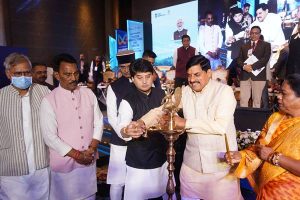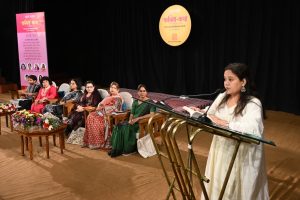
A two-day literary festival commenced with an invocation to the Goddess of Speech (Vani Vandana), as poets and storytellers shared their thoughts through the recitation of their works.
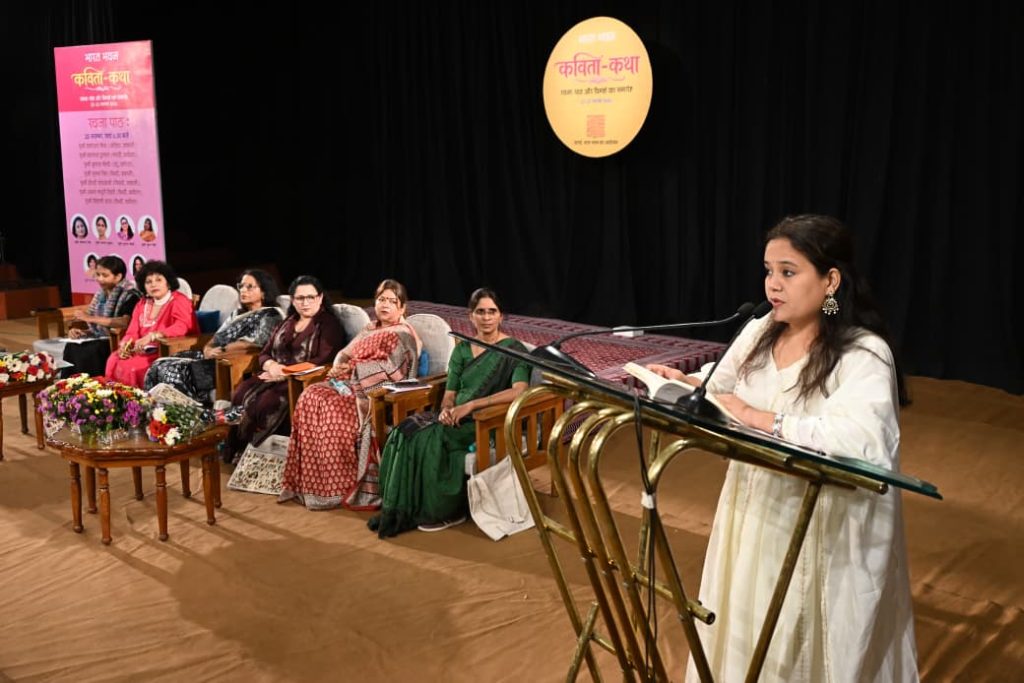
Bhopal: On Sunday, a two-day literary festival titled ‘Kavita-Katha’ (Poetry-Story) was organized by ‘Vagarth,’ the Centre for Indian Poetry at Bharat Bhavan. Focused on literary readings and intellectual discourse, the first day of the event featured writers, poets, and storytellers from various Indian languages, who explored diverse facets of life, society, human sensibility, and the times through their creative works.
The program opened with a ‘Vani Vandana’ (invocation to the Goddess of Speech) performed by Sangeeta Goswami and her fellow artists. This was followed by a session where authors writing in Odia, Marathi, Urdu, Sindhi, and Hindi recited their poems, ghazals, and stories.
Sangeeta Goswami and her group began the proceedings with a rendition of ‘Namo Namo Jayashri Saraswati Dayani…’, followed by ‘Varde Veena Vadani…’, infusing the literary gathering with the spirit of an invocation to Goddess Saraswati. This blend of music and words created a dignified atmosphere for the festival. The introductory remarks for the event were delivered by Chief Administrative Officer Prem Shankar Shukla.
Creative Expression as a Symbol: During the reading session, Hindi poet Vaishali Thapa presented poems ‘Akashvani’ and ‘Dukh Oob Jayega’ (Sorrow Will Grow Weary). She explored the relationship between sorrow, life, and the sensibilities that emerge within a human being.
Urdu poet Dr. Nusrat Mehdi highlighted the importance of dialogue in life through her ghazal. Lines from her ghazal—“Chhod vahmo-guman, baat kar, ai mere hamzaban, baat kar” (Cast aside doubts and misgivings; let us talk, O kindred spirit, let us talk)—underscored the necessity of dialogue and the significance of communication within relationships.
In verses such as “Baat bigdi nahi hai abhi, baat kar meri jaan, baat kar” (Things have not yet reached a point of no return; let us talk, my dear, let us talk), she conveyed the message that dialogue can help bridge distances and resolve misunderstandings.
Marathi poet Kalpana Dudhal presented a poem titled “Baki sapne ab veeran lagte hain” (The remaining dreams now seem desolate). During the first day’s readings, Odia fiction writer Yashodhara Mishra, Hindi fiction writer Suman Singh, Sindhi fiction writer Dropadi Chandnani, and Hindi poet Anna Madhuri Tirkey also presented their work. The participation of writers from various linguistic backgrounds brought the multilingual and multidimensional tradition of Indian literature onto a single platform.