
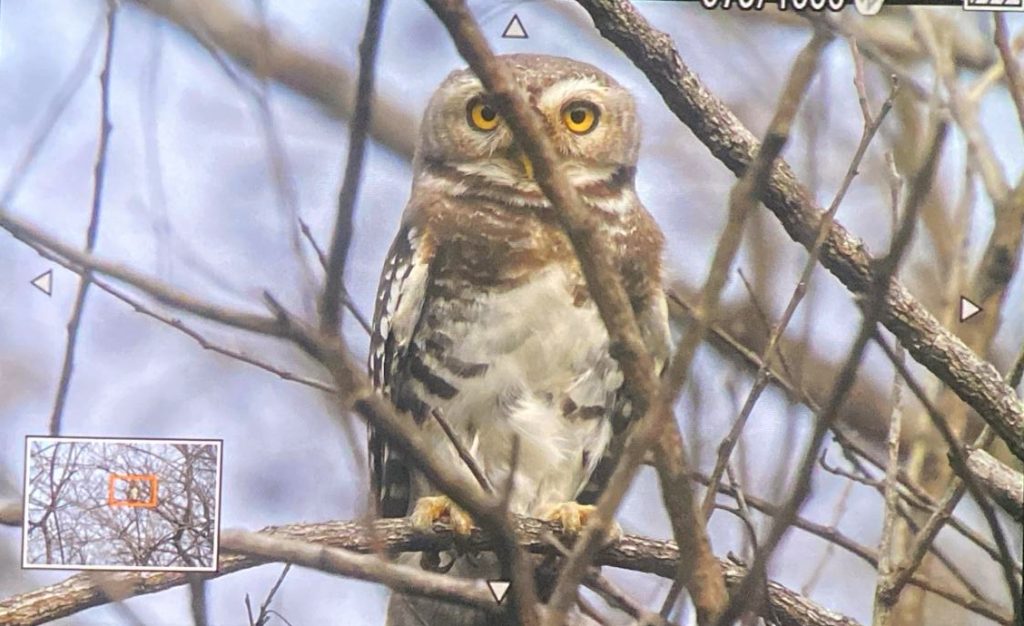
In a significant development in the field of ornithology, the endemic and endangered Forest Owlet (Athene blewiti) has been sighted for the first time in MP’s Kuno National Park, marking a significant expansion of the species’ known distribution.
The discovery of the Forest Owlet in Kuno National Park is a significant event for biodiversity conservation in India. This discovery is extremely important given that it is one of the world’s rarest raptors and has potential ecological implications for habitat management related to Project Cheetah.
The Forest Owlet is an endemic bird of central India. It was first discovered in 1872 but was considered extinct after 1884. After a long hiatus of approximately 113 years, it was rediscovered in 1997 in the Nandurbar district of Maharashtra, creating a sensation in the world of ornithology.
It is currently found in fragmented forest areas of central India, including parts of Madhya Pradesh (Khaknar, Piplod), Maharashtra (Toranmal, Melghat), and Gujarat (Dang, Purna Wildlife Sanctuary).
In Madhya Pradesh, the Forest Owlet was previously found only in the eastern Khandwa, Burhanpur, and Betul districts. This rare bird was first spotted in Kuno by Labh Yadav, a local tourism official, during a field trip to the Parond Beat, immediately attracting the attention of the Forest Department due to the species’ extremely limited distribution and conservation status.
Based on key identification features, Vivek Patel of the Wildlife Research and Conservation Society, Pune, confirmed the sighting on the spot, making it the first authentic record of the species from Kuno National Park.
Unlike most owls, the Forest Owlet is primarily diurnal. It is most active between 6:00 and 10:00 a.m. and can be seen perched on the branches of tall trees even in the harsh sunlight.
The Forest Owlet is currently listed as “Endangered” by the International Union for Conservation of Nature. Its total global adult population is estimated to be between 250 and 999.
Further surveys are needed to understand its distribution in Madhya Pradesh. The Forest Owlet, once thought extinct and rediscovered in 1997, currently exists in limited areas of central India and faces a constant threat from habitat degradation and fragmentation. This new record highlights the ecological importance of the forests of Kuno National Park.
The sighting of the Forest Owlet suggests that conservation efforts for the cheetah are improving ecosystems and leading to the recovery of other endangered species. The discovery of this species in the northwestern region of Madhya Pradesh has sparked enthusiasm among bird conservationists.