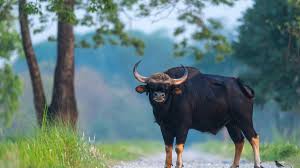
On the first day of the second phase of the translocation of a total of 50 Gaurs from Satpura Tiger Reserve to Bandhavgarh Tiger Reserve, five Gaurs, including one male and four females, were successfully released today into the specially constructed Gaur enclosure in the Kalwah range of Bandhavgarh Tiger Reserve in the presence of the Field Director and Deputy Director.
These Gaurs were captured on January 22, 2026, by the reserve team from a forest area near Churna, under the leadership of the Field Director, Mrs. Rakhi Nanda, and Dr. Parag Nigam, a scientist from the Wildlife Institute of India (WII).
This gaur reintroduction program is being carried out under the project “Population Management Strategies for Gaur: Supplementation of Gaur in Bandhavgarh Tiger Reserve, Madhya Pradesh,” through the joint collaboration of the Wildlife Institute of India (WII) and the Madhya Pradesh Forest Department, with the objective of ensuring genetic diversity in the Gaur population.
In the first phase of this project, 22 Gaurs were successfully reintroduced to Bandhavgarh Tiger Reserve in February 2025. In the second phase of this Gaur translocation operation, which is being conducted from January 22 to 25, 2026, a total of 27 Gaurs are proposed to be translocated from Satpura Tiger Reserve to Bandhavgarh Tiger Reserve.
A total of nine transport teams have been formed for the transportation of the Gaurs, each team comprising a Sub-Divisional Forest Officer/Forest Ranger, a Gaur transport vehicle, two wildlife veterinarians, forest guards, and other staff, totaling 10 members and 4 vehicles.
It is noteworthy that Gaurs became extinct in the Bandhavgarh landscape in the 1990s. The reintroduction of Gaurs in the area began in 2010-11, when 50 Gaurs were translocated from Kanha Tiger Reserve to Bandhavgarh Tiger Reserve. This effort was highly successful, and currently, the number of Gaurs in Bandhavgarh Tiger Reserve has increased to more than 191.
This entire campaign is a significant achievement towards strengthening the Gaur population and maintaining genetic diversity in Bandhavgarh Tiger Reserve, contributing to biodiversity conservation and ecological balance.