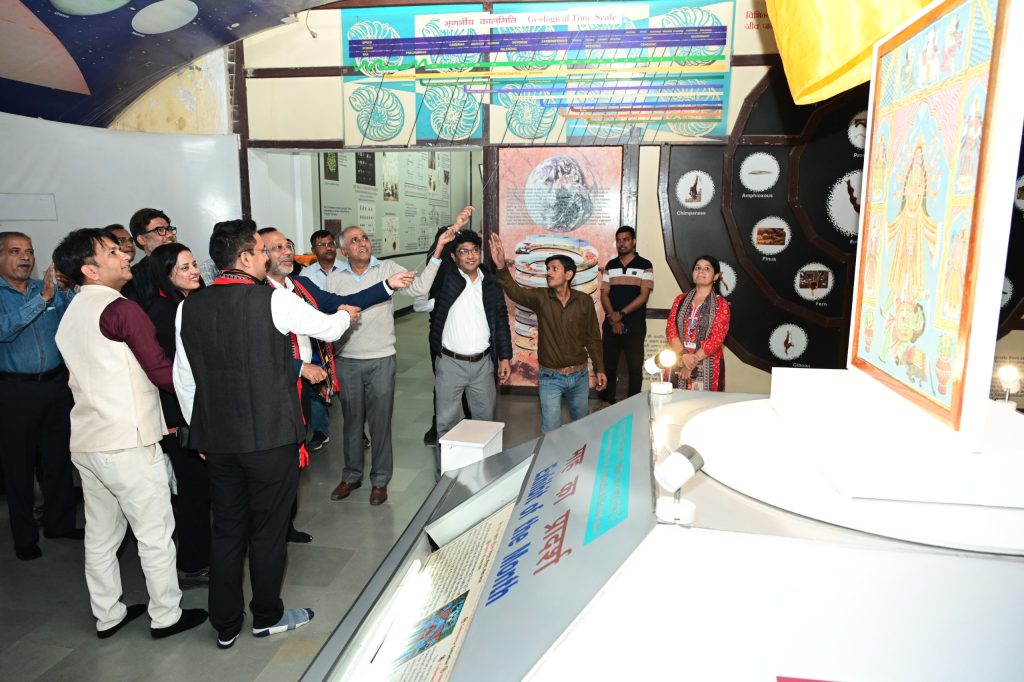
A special exhibition titled ‘Chhoto Thakurani – Sacred Scroll Paintings of Bishnupur’ was organized today at the Vithi Sankul (Gallery Complex) as part of the ‘Exhibit of the Month’ program at Bhopal’s Indira Gandhi Rashtriya Manav Sangrahalaya (IGRMS).
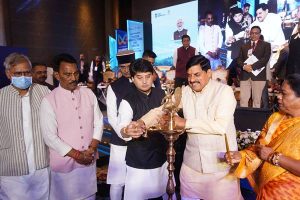
The exhibition was inaugurated by Professor Shailesh Kumar Agrawal and Ms. Ajra Mahavish from the National Institute of Disaster Management (NIDM), New Delhi. The Director of the institute graced the occasion with their presence, which was also attended by various officers and staff members of the institute.
The exhibition showcases a traditional ritualistic art form from Bishnupur, in the Bankura district of West Bengal, which is associated with the worship of Goddess Durga. Known as ‘Pater Durga’ or ‘Patereshwari,’ this artistic tradition is an integral part of the historical, religious, and cultural heritage of Bishnupur. Its roots lie in the ancient tradition of Durga Puja, which dates back to the reign of the Malla kings.
Three manifestations of Durga: In the religious tradition of the Bishnupur Rajbari (royal household), three manifestations of Goddess Durga—Boro Thakurani, Mejo Thakurani, and Chhoto Thakurani—hold special significance.
Each of these forms is worshipped on specific, designated dates. The rituals commence on ‘Jitastami’ (during the waning phase of the moon in the month of Ashvin) with the installation of the scroll of ‘Boro Thakurani.’ This is followed by the worship of ‘Mejo Thakurani’ on ‘Shashthi’ and ‘Chhoto Thakurani’ on ‘Saptami.’ The entire religious observance spans approximately 15 to 20 days.
These sacred scroll paintings are created by traditional artists from the ‘Faujdar’ family, using natural pigments on specially prepared canvases. The creation process begins by layering multiple sheets of cloth, which are bonded together using a natural adhesive to form a durable canvas. Following this, a layer of clay is applied to the surface to make it smooth.
During the painting process, the outlines of the figures are drawn with fine lines, and then filled with vibrant, flat colors. Traditionally, turmeric is used for yellow, lamp soot for black, extracts from leaves and vegetation for green, and chalk (white clay) for white. Other colors are derived from natural minerals and botanical sources. A natural adhesive, made from tamarind seeds, is used to ensure the durability of the colors.
The central composition of the painting depicts Goddess Durga slaying the demon Mahishasura. This form represents divine feminine power—or Shakti—symbolizing the triumph of good over evil and the establishment of cosmic balance. Alongside the Goddess, her divine family—Ganesha, Kartikeya, Lakshmi, and Saraswati—are also depicted, representing prosperity, courage, splendor, and knowledge, respectively.
The Pater Durga painting tradition of Bishnupur is not merely an expression of religious faith; it serves as a vital record of the community’s collective memory, social traditions, and artistic knowledge preserved through generations. Safeguarded by the Faujdar family of painters, this artistic tradition encompasses the transmission of traditional painting techniques, religious symbols, and ritualistic responsibilities from one generation to the next. In this tradition, the artist is not just a painter, but an integral part of the community’s cultural and religious life.
Through the ‘Exhibit of the Month’ program, efforts are being made to showcase the nation’s diverse traditional art forms, cultural heritage, and folk arts, while fostering awareness for their preservation, promotion, and dissemination.
The details of the exhibited artwork are as follows: It is titled ‘Chhoto Thakurani – Sacred Pata Chitra (Scroll Painting) of Bishnupur.’ It belongs to the traditional art form of the Sutradhar community. It is housed at Mouslala, Shankhari Bazar, Bishnupur, Bankura, West Bengal. The artwork was collected by Dr. Soma Kiro.