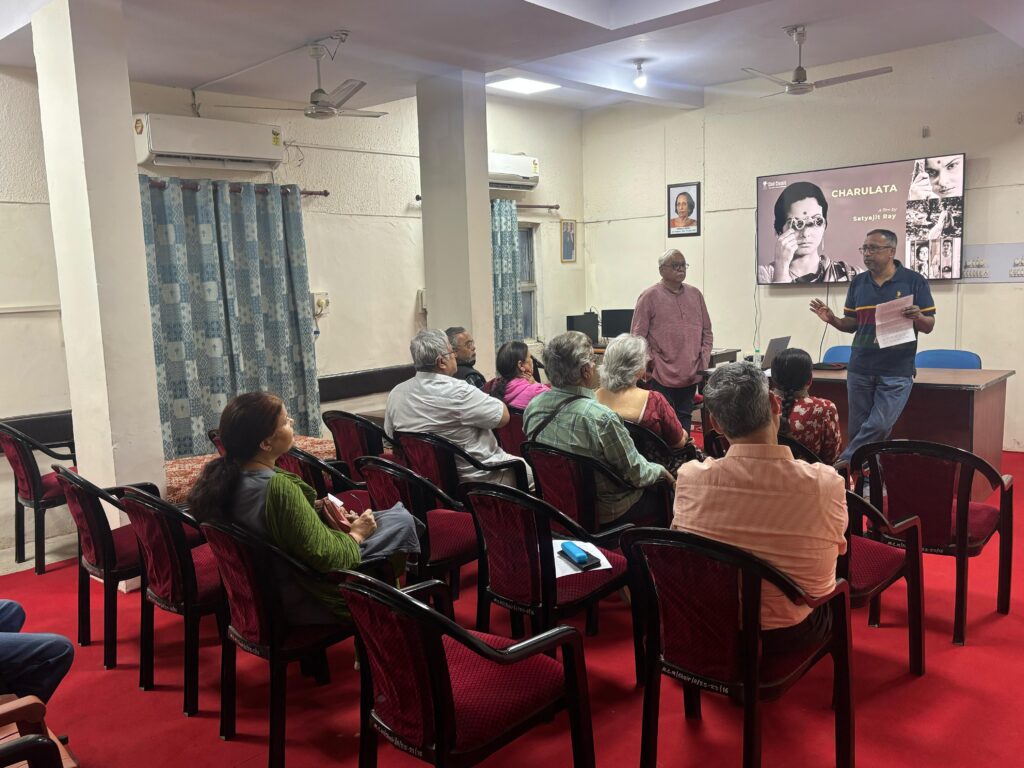
Bhopal. Satyajit Ray’s widely regarded masterpiece Charulata was screened today at the Conference Hall of Mahila Chetna Manch in Shivaji Nagar. 117 minute film made in 1964 is based on Rabindranath Tagore’s story Nastanirh (The Broken Nest), is an emotional and profound narrative set in late 19th-century Calcutta.
It revolves around Charulata, a childless and lonely woman from an aristocratic family, who feels a sense of incompleteness due to the neglect of her busy editor husband. Her life takes a turn when her husband’s young, charming, and artistically inclined cousin comes to stay with them, leading to a deep intellectual and emotional bond between them.
Introducing the film, Amitava Mandal described it as a chamber drama, with over ninety percent of its scenes shot within a single grand house. The film presents a nuanced exploration of loneliness, intellectual companionship, and unspoken love, set against the backdrop of 19th-century Bengal’s cultural renaissance. He pointed out that while the film explores the theme of an extramarital relationship, it does so on a purely emotional and intellectual level.
Mandal further said One of Charulata’s greatest strengths lies in Ray’s command over Cine’matic language. The opening sequence itself, where the lonely Charu (played brilliantly by Madhabi Mukherjee) glides through the house, peering through opera glasses at the world outside, sets the tone for her isolation. The visual storytelling speaks volumes even before a word is uttered.
Ray’s use of mise-en-scène enhances this theme of entrapment. The elegant interiors of the home, while lavish, act as a gilded cage for Charu. The camera often frames her through doorways and windows, symbolizing her emotional and intellectual confinement.
In contrast, when Amal (Soumitra Chatterjee) enters her life, the spaces open up—gardens, books, and the creative exchange of ideas signify the brief liberation she experiences.
Additionally, Bhupati (Shailen Mukherjee), Charu’s husband, though well-acted, is presented with an almost excessive nobility. His betrayal—losing his newspaper and being deceived by his associates—elicits more sympathy than his emotional neglect of Charu.
While this serves Ray’s intention of portraying a tragedy without villains, it somewhat dilutes the film’s emotional conflict. A sharper critique of his obliviousness could have made Charu’s loneliness even more resonant.
Subrata Mitra’s fluid and expressive Cine’matography beautifully enhances Ray’s visual storytelling. The use of symbolic framing and natural light adds to the film’s impact. The meditative and thoughtful rhythm of the film is shaped by Dulal Dutta’s masterful editing, which skillfully employs dissolves and jump cuts to delve into the characters’ inner emotions.
Satyajit Ray himself composed the film’s music, blending the melody of Indian ragas with the harmony of Western classical music to create a unique flow. Instead of a grand orchestration, he opted for a minimalistic use of instruments. Kishore Kumar’s song Bideshini is particularly melodious, and in many key scenes, the interplay of ambient sound and silence generates a profound emotional effect.
Madhabi Mukherjee delivers a remarkable performance as Charulata, bringing new depth to the character. Soumitra Chatterjee also makes a striking impression, especially in the film’s iconic opening seven minutes, which encapsulate the entire narrative.
The screening saw a large turnout, followed by an engaging discussion among the audience.