Bhopal. On the occasion of World Population Day, the National Centre for Human Settlements and Environment (NCHSE), in association with Cine’ Classic, organized a screening of the acclaimed documentary 8 Billion Angels. The event witnessed enthusiastic participation from students, environmental enthusiasts, researchers, teachers, and concerned citizens.
This thought-provoking documentary explores the impact of the world’s growing population on the environment, biodiversity, climate change, food security, and natural resources. Through the perspectives of scientists, environmentalists, educators, and policy experts, the film raises important questions about the direction in which humanity is heading on a planet with finite resources.
The central message of the film is that population, consumption, and environmental crises are deeply interconnected. The documentary not only highlights these challenges but also discusses humane and democratic solutions such as women’s education, gender equality, informed citizenship, and voluntary family planning. It encourages viewers to reflect on how achieving a balance between development and environmental conservation will be one of the greatest challenges of the future.
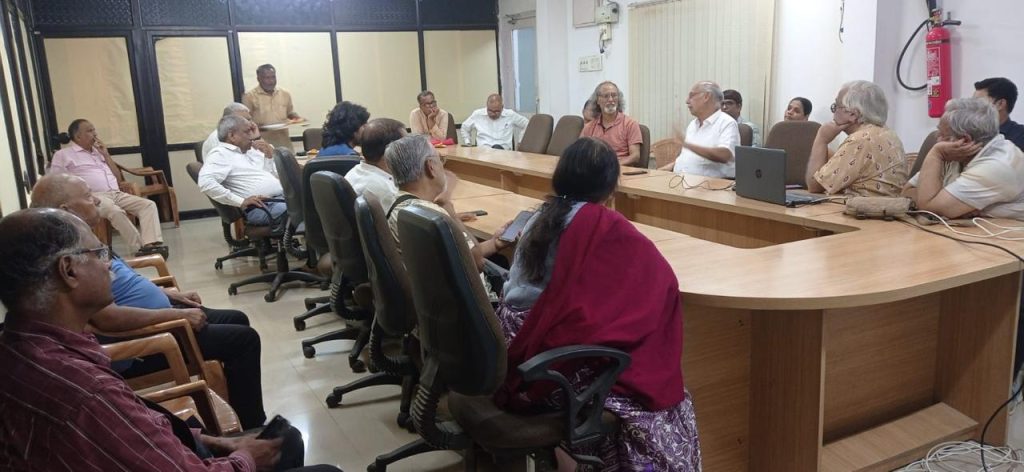
During the discussion that followed the screening, participants shared their views on population growth, unequal distribution of resources, increasing consumption patterns, and environmental degradation. A key point that emerged was that not only population size, but also patterns of resource use and lifestyle choices, significantly influence the future of the planet.
Health, social science, and population expert Dr. Alok Ranjan Chaurasia presented several important facts and statistics related to population trends. He explained that over the past few decades, the expansion of family planning, education, and healthcare services has led to a significant decline in population growth rates. He noted that fertility rates in India and many other countries are now approaching or falling below replacement levels. As a result, declining population, population ageing, and a shrinking working-age population may emerge as major challenges in the future.
Dr. Chaurasia emphasized that the need today is not merely population control but balanced and sustainable population management to effectively address social, economic, and environmental challenges. He also remarked that children must continue to be born for societies and economies to function and sustain themselves.
NCHSE Director General and senior environmentalist Dr. Pradeep Nandy stated that population imbalance has one of its most direct and serious impacts on the environment. Increasing population places continuous pressure on land, water, forests, biodiversity, and other natural resources. He stressed that achieving sustainable development and environmental protection requires a careful balance between population, resource use, and lifestyle choices.
Cine’ Classic curator Sunil Shukla said that World Population Day is not merely an occasion to reflect on demographic statistics, but also an opportunity to understand the deep connections between population, environment, development, and quality of life. He noted that films such as 8 Billion Angels help initiate meaningful dialogue by presenting complex global issues in a simple and compelling manner.
The audience described the film as highly relevant, balanced, and thought-provoking. The event emerged as much more than a film screening; it became an opportunity for serious reflection on the shared future of humanity and the Earth. Among those who actively participated in the discussion were Bharat Patel, Ashutosh Vyas, Dr. Role, and Deepak Sharma.