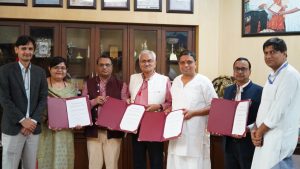

The Union Ministry of Environment, Forest and Climate Change (MoEFCC) and the National Biodiversity Authority (NBA) have launched a landmark five-year project for biodiversity conservation. The project is a joint initiative of the Government of India, the Global Environment Facility (GEF) and the United Nations Development Programme (UNDP), with a grant of USD 4.88 million for the period 2025–2030.
The project is rooted in two ecologically significant landscapes. In Tamil Nadu, the Sathyamangalam landscape at the confluence of the Western and Eastern Ghats, encompassing the Mudumalai Tiger Reserve and Sathyamangalam Tiger Reserve, unites forest-fringe communities who are longstanding stewards of wildlife corridors. Their deep ecological knowledge will be channelled into Gram Panchayat Development Plans (GPDPs), giving biodiversity conservation a prominent place in local governance.
Similarly, in Garo Hills, Meghalaya, the Nokrek Biosphere Reserve, Balpakram National Park, and Siju Wildlife Sanctuary together form a vibrant mosaic of government forests and Reserve Forests, providing an ideal setting for community-led conservation woven into Village Employment Councils (VECs), an equivalent of gram panchayats.
A key objective of the project is mainstreaming biodiversity in local developmental plans to strengthen Panchayati Raj Institutions (PRIs) and Biodiversity Management Committees (BMCs) and bring together forest departments, revenue authorities, elected representatives and civil society to produce community-owned, funded biodiversity plans.
Another major objective is to promote innovative financing mechanisms by activating Access and Benefit Sharing (ABS) arrangements, CSR co-financing and green micro-enterprises that create sustainable livelihoods as direct rewards for conservation stewardship. The third objective focuses on knowledge management and capacity building, systematically capturing innovations from both landscapes for nationwide replication through NBA and MoEFCC platforms, with a dedicated focus on advancing the economic and governance roles of women, Scheduled Castes and tribal communities.
The governance architecture is based on a bottom-up approach, with Panchayati Raj Institutions playing a key managerial role.