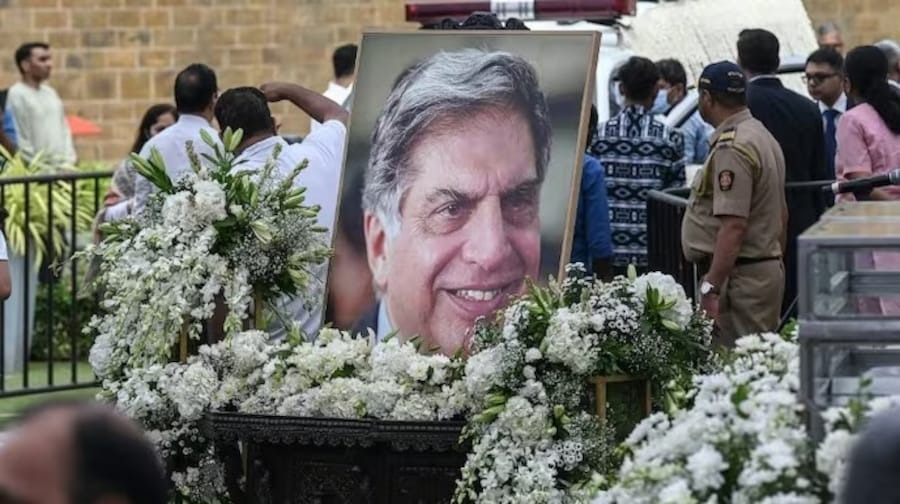
On Thursday, India bid a final farewell to Ratan Tata, industry stalwart and former chairman of Tata Sons, with full state honors. The ceremony saw attendance from a wide array of eminent personalities from politics, business, and other fields.
Union Home Minister Amit Shah, Reliance Group Chairman Mukesh Ambani, Maharashtra Chief Minister Eknath Shinde, and Reserve Bank of India (RBI) Governor Shaktikanta Das were among those who gathered at Nariman Point in Mumbai to pay their respects.
In honor of Ratan Tata’s contributions to the nation, the state of Maharashtra declared Thursday a day of mourning. As a mark of respect, the national flag was flown at half-mast across all government offices in the state. This gesture reflected the deep admiration the country holds for Tata, who was known not only for his business acumen but also for his dedication to social causes and his visionary leadership.
Prominent figures from various sectors expressed their condolences and paid tribute to Tata. Gujarat Chief Minister Bhupendra Patel, business magnates like Mukesh Ambani and Kumar Mangalam Birla, and several political leaders joined in remembrance of the industrialist’s legacy. Veteran Bollywood actor Amitabh Bachchan also shared his sentiments, writing, “An era has ended,” emphasizing the profound impact Ratan Tata had on India’s industrial and social landscape.
Ratan Tata’s contributions extended far beyond the business world. His leadership at Tata Sons and his involvement in philanthropy, education, and healthcare initiatives made him a beloved figure across the country. He was a guiding force behind many charitable causes, ensuring that the Tata Group’s influence was felt not just in the corporate sector but in the betterment of society as a whole.
The Maharashtra Cabinet, led by Chief Minister Eknath Shinde, formally recommended that the central government bestow India’s highest civilian honor, the Bharat Ratna, upon Ratan Tata. This proposal was passed unanimously by the cabinet, which hailed Tata as a “great social worker, visionary, and patriotic leader.”
Ratan Tata’s mortal remains were kept at the National Center for Performing Arts (NCPA) at Nariman Point, where thousands of people gathered to pay their final respects. The viewing was open to the public from 10 am to 4 pm, allowing mourners from all walks of life to honor the legacy of one of India’s most respected figures.
Following this, Tata’s final journey proceeded to the Worli crematorium, where the last rites were performed according to Hindu customs. The ceremony was solemn and dignified, with 45 minutes of prayers and the final state honors. It was a poignant farewell to a man who had shaped the industrial landscape of India for decades.
One of the most emotional moments came when Shantanu Naidu, Tata’s trusted aide and close confidante, emerged from the Worli crematorium after the last rites were completed. Naidu, who had worked closely with Tata in various capacities, was visibly moved as he bid his final farewell.
Ratan Tata’s passing marks the end of an era, but his legacy will continue to inspire generations to come. From transforming Tata Sons into a global entity to his unwavering commitment to social causes, his life was a testament to leadership rooted in ethics, vision, and compassion.