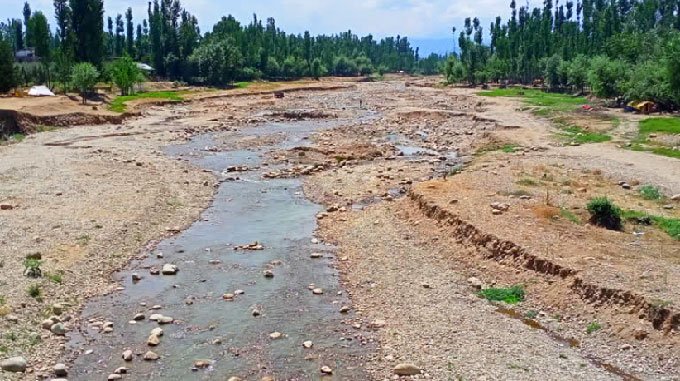
The crisis facing our rivers is not merely one of water scarcity; it concerns the nation’s future and its environmental balance. On one hand, the natural flow of water in rivers is steadily weakening, while on the other, pollution has cast serious doubt on their very survival
A recent study by researchers at the Indian Institute of Technology (IIT) Gandhinagar presents a grim picture of this dual crisis. According to the study, approximately 30 percent of monitoring stations across the country’s major river basins have recorded a significant decline in ‘baseflow’—the portion of river flow sustained by groundwater—between 1961 and 2021. This serves as a warning that even our perennial rivers could face severe water shortages during the summer months in the future.
The research analyzed six decades of data from 227 monitoring stations across 18 major river basins. In the Sabarmati, Kaveri, Pennar, and southern coastal river basins, the decline in baseflow was found to exceed 30 percent. Major rivers such as the Ganga, Brahmaputra, Narmada, Mahi, Mahanadi, and Krishna also showed a decline of 10 to 25 percent at several monitoring stations.
Groundwater is estimated to contribute 60 to 70 percent of the total annual flow in rivers like the Ganga and Brahmaputra. Consequently, the falling groundwater level poses a grave threat to the future of these rivers.
There are several reasons behind the declining water levels in rivers. Key factors include the unchecked extraction of groundwater for irrigation and industrial use, shifting rainfall patterns, prolonged dry spells during the monsoon, deforestation, and rapid urbanization.
The natural process by which rainwater percolates into the ground has been disrupted. Furthermore, traditional water sources—such as ponds and wells—have fallen victim to encroachment and neglect.
As a result, rainwater simply flows away, leaving groundwater reserves unable to replenish. The growing pollution in our rivers is exacerbating this crisis. Untreated urban sewage, industrial waste, chemical fertilizers, pesticides, and plastic debris are continuously finding their way into our river systems.
From the Ganga and Yamuna to the Narmada, Kshipra, and others across the country, no river remains unaffected. The dire state of these rivers—which are deeply intertwined with our religious faith and cultural life—is a matter of grave concern.
As water levels in rivers decline, the concentration of pollutants increases, further degrading water quality. This has a direct, adverse impact on drinking water supplies, agriculture, fish populations, and aquatic life.
River conservation cannot be limited merely to cleaning drives or the beautification of riverbanks (ghats). It requires controlling groundwater extraction, promoting rainwater harvesting, protecting catchment areas, and maintaining the natural flow of rivers. In urban areas, alongside expanding the capacity of sewage treatment plants, it must be ensured that not a single drop of untreated wastewater enters our rivers. Furthermore, there must be strict monitoring of waste from industrial units, coupled with regular enforcement actions.
Rivers are more than just streams of water; they are the foundations of our civilization, economy, and life itself. Protecting them is a responsibility shared by both the government and society. If we lose our rivers in the race for development, the water crisis facing future generations will become even more severe. It is time to elevate river conservation beyond mere government schemes and establish it as a national priority. Only by ensuring both the availability of water in our rivers and the purity of that water can we achieve the goals of water security and environmental conservation.